Page updated on July 15, 2026.
Binance is the world’s largest cryptocurrency exchange and is used by millions of people every day. Unlike Coinbase or Crypto.com that buy image rights and pay advertising to appear at the most popular sporting events, Binance has become popular organically, from user to user.
In this article we will explain what the Binance referral ID is, how to fill it out and what the benefits are. Are you ready?
What is the Binance Referral ID (Optional)?
During Binance sign-up, you may see a field called Referral ID, Referral Code, or Inviter (Optional). Entering the valid Referral Pro code: ASYQFPUG links your account to the inviter. Binance permits a shared rebate of up to 20% on eligible Spot and Margin fees and up to 20% on Futures. Any additional welcome bonus or promotional reward is governed by separate campaign terms, may require additional tasks, and is not guaranteed.
Use the referral code ASYQFPUG or B9WS7LCW during account registration to receive the 20% lifetime discount on spot trading fees and up to $100 to $600 in welcome vouchers subject to campaign terms.
Reference: referral code for Binance (article).
“20% discount” vs “20% kickback” (important)
Many sites call this a “20% discount,” but Referral Pro is typically best understood as a rebate/kickback:
- Binance charges the normal trading fee when you place trades.
- Then Binance credits a portion back to you as a kickback based on the kickback rate (up to 20%).
Binance is using USDC as the default settlement token for Referral Pro commissions/rebates in many regions. Binance calculates commissions hourly and deposits the USDC into your Spot wallet within up to 6 hours after commission is generated.
Official reference:
- https://www.binance.com/en/support/announcement/detail/9490ef81489844a6babc385eba238d75
- https://www.binance.com/en/support/faq/detail/6233094e540b4ea4ac50387d1518911b
Regional note (important): settlement token/wallet can differ by jurisdiction and product. For example, Binance has described specific handling for EEA users for certain Futures commissions. Always treat the official terms and FAQs as the source of truth for your region.
Binance may also show optional campaign tasks inside Rewards Hub (welcome missions, vouchers, etc.). These extras are not guaranteed, change frequently, and vary by region.
Note: You can register either through Referral Pro (ongoing kickback) or Referral Lite (time‑limited voucher), not both.
After entering this code, you will see a message saying “Your commission kickback rate: 20%” as in the image below:
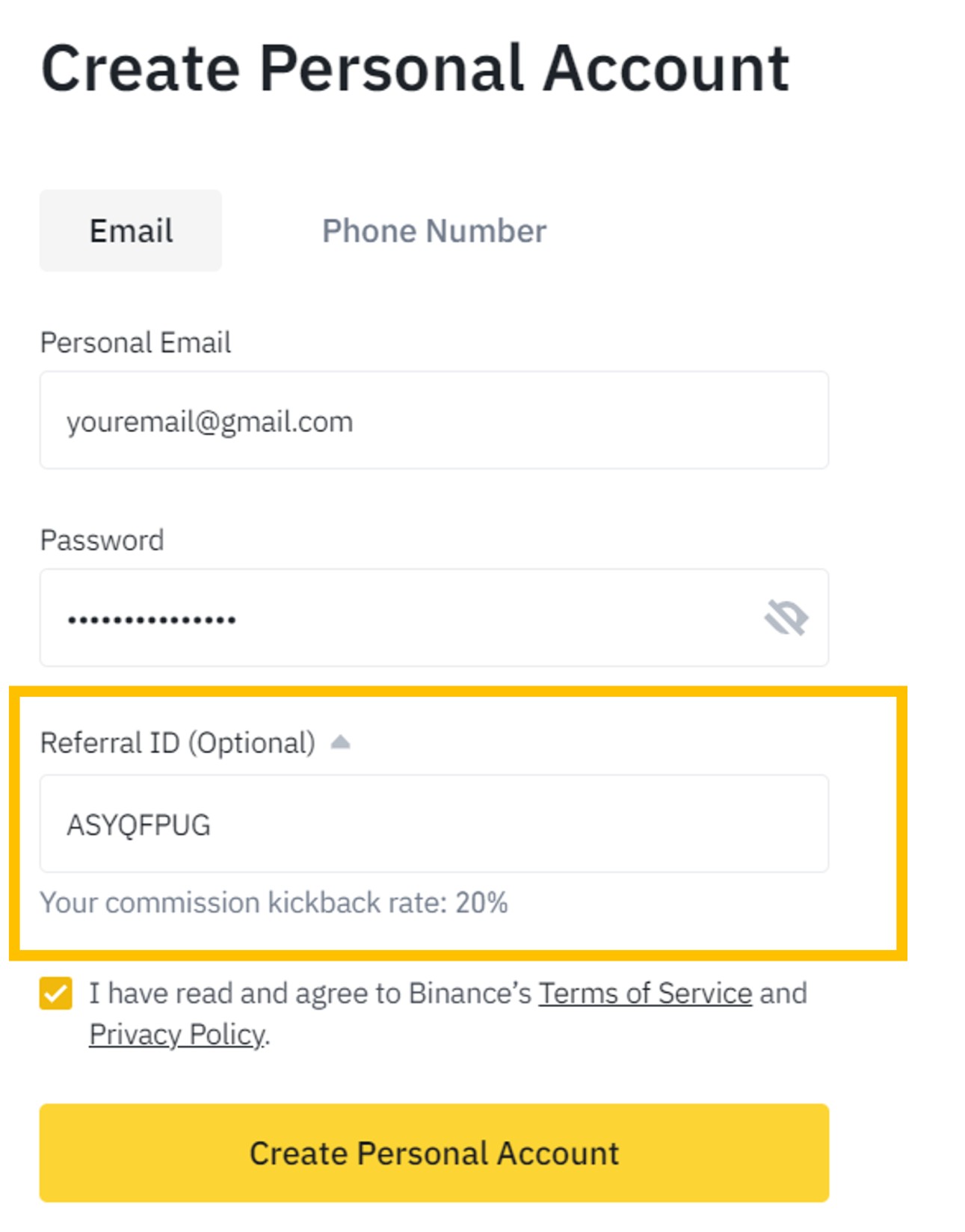
This means your account is linked to a referral relationship where you can receive up to 20% back on eligible trading fees you pay (as a rebate), subject to Binance’s rules and your region.
How long does the 20% apply?
Binance does not promise this as “lifetime.”
In Referral Pro, your kickback is a share of your inviter’s commission. If Binance stops generating commission on your trading activity for that inviter (due to product rules, VIP thresholds, or time limits), your kickback can stop as well.
What is the easiest way to sign up at Binance with an invite code?
For beginners who like convenience, the easiest way to enter the Binance Referral ID is to click on this link to sign up: Binance Register. This way, since the registration link already contains the code, you just need to create your account as usual, without having to enter any code, as it will already be saved and associated with your account.
Security tip: Always verify you’re on the official domain (accounts.binance.com) before entering your email/phone, password, or verification codes.
What is a Binance Inviter (Optional)?
During the registration process on Binance, you’re asked if you have an Inviter (Optional). An inviter is simply the person (or website) that referred you.
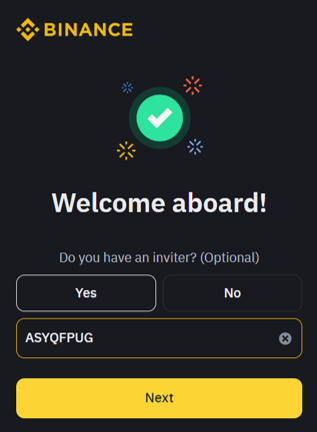
If you select “YES” and enter the referral code ASYQFPUG, Binance should display your kickback confirmation (for example, “Your commission kickback rate: 20%”).
The image below is the current “Binance Inviter” field:
Futures Market Referral Inviter
Many users search for a “Binance Futures referral code.” In most cases, you don’t need a separate Futures code:
- You create one Binance account that can access both Spot and Futures.
- The same referral relationship applies across products.
However, Futures has extra conditions that matter:
- Futures rebates can stop after the inviter’s Futures commission validity period expires (commonly 12 months), unless the inviter qualifies for a tier that waives the time limit.
- For the inviter to earn Futures commission on your trades (and share a Futures rebate with you), the inviter generally needs to have their own Futures account activated before you open yours.
Official reference: https://www.binance.com/en/support/faq/detail/6233094e540b4ea4ac50387d1518911b
Next Steps after registering the referral code
After signing up with a referral code, the next steps to maximize your benefits (and avoid missing time‑limited campaigns) are:
- Complete identity verification (KYC)
- Open Rewards Hub and look for tasks/campaigns available to you
- Deposit or buy crypto and start trading only if you understand the risks
Bonuses are campaign‑based and not guaranteed. Requirements and availability vary by region.
Identity Verification (KYC): Unlocking the Full Binance Bonus
KYC is a standard identity verification process used by regulated exchanges. On Binance it can unlock higher limits, more features, and eligibility for some Rewards Hub campaigns.
Starting the KYC process is straightforward:
- Navigate to your profile section.
- Click on “Account” and select “Verification”.
- Follow Binance’s step-by-step guide (personal info + identity documents; sometimes proof of address).
Important: Completing KYC does not automatically guarantee a USDT sign‑up bonus. Any extra rewards are usually delivered via Rewards Hub campaigns and can be vouchers (e.g., trading fee rebate vouchers), not direct USDT deposits.
Making Your First Deposit
After creating and verifying your Binance account, you can fund it using fiat or crypto.
Step 1: Navigate to the ‘Fiat and Spot’ Page
- Log in to your Binance account.
- Click “Wallet” in the upper right corner.
- Select “Fiat and Spot.”
Step 2: Select the ‘Deposit’ Option
- On the ‘Fiat and Spot’ page, click “Deposit.”
Step 3: Choose the Deposit Method
- Choose whether to deposit fiat money or cryptocurrency.
- For fiat: select your currency and payment method (bank transfer, card, etc.).
- For crypto: select the coin/token you want to deposit.
Step 4: Follow the Specific Deposit Procedure
- Fiat deposit:
- Choose the payment method.
- Enter the deposit amount.
- Follow the bank/payment instructions shown by Binance.
- Wait for processing.
- Crypto deposit:
- Select the cryptocurrency.
- Binance generates a deposit address (and network).
- Copy the address / scan the QR code.
- Send from your wallet/exchange to Binance on the correct network.
Warning: Sending to the wrong address/network can result in permanent loss.
Step 5: Confirm the Deposit
- Wait for network confirmations or bank processing times.
- Funds appear in your Binance ‘Fiat and Spot’ wallet.
Note (important for Referral Lite): A “deposit” is not the same thing as a “purchase.” Some Referral Lite campaigns require cumulative crypto purchases worth more than $50 within 14 days after registration. Deposit‑based campaigns can have exclusions (for example, internal transfers from another Binance account may not count). Always follow the exact task wording shown in Rewards Hub.
How the 20% kickback is calculated (simple example)
Treat the calculation below as an illustration, not a guaranteed payout. Starting from April 29, 2026 for Spot and July 15, 2026 for Futures, Binance calculates referral commissions using the following formula:
Commission = Net Fees × Commission Rate
Net fees are the transactional income remaining after applicable market-maker rebates.
The referred user receives a rebate only when the inviter shares part of the base referral bonus, so an apparent $1 trading fee will not necessarily produce exactly $0.20 in rebate. Trades that generate no trading fee do not generate referral commission.
Can you stack the referral kickback with other Binance fee discounts?
Often, yes. Three common ways users reduce fees are:
- VIP tiers (based on volume / balances)
- Paying fees with BNB (BNB fee deduction)
- Referral Pro kickback (rebate) from the inviter
BNB fee deduction (official Binance FAQ):
- Save 25% on Spot & Margin trading fees
- Save 10% on Futures trading fees (Reference: https://www.binance.com/en/support/faq/detail/115000583311)
In practice, VIP/BNB typically reduce fees at the moment they’re charged, and the Referral Pro kickback is based on the fees actually paid, so all of this works together to reduce your net fees.
How to check if the referral code worked (and track your rebates)
The most reliable checks are:
- During sign‑up, Binance displays the kickback rate (example: “Your commission kickback rate: 20%”).
- After you start trading, look for rebate credits:
- In many regions, Referral Pro rebates are credited in USDC to your Spot wallet.
- Binance states that referees can check details under the [Share Commissions] subsection on the Referral Pro page.
Official reference: https://www.binance.com/en/support/announcement/detail/9490ef81489844a6babc385eba238d75
Important: Binance states that a referral code must be used at the time of account creation. If you forget it (or enter the wrong one), you generally cannot add/change the referral relationship later.
Official reference: https://www.binance.com/en/support/faq/detail/6233094e540b4ea4ac50387d1518911b
Common mistakes that can reduce or break your referral benefits
These are common issues users run into:
- Trying to add/change the referral code after sign-up: usually not possible once the referral relationship is set.
- Opening multiple accounts with the same identity (KYC): Binance has stated that duplicate identity behavior can lead to commissions being terminated and the user becoming ineligible to receive rebates.
- Confusing Referral Pro vs Referral Lite: they are not combinable; you can be referred through one mode only.
- Assuming KYC automatically gives USDT: rewards are campaign-based and vary by region.
- Expecting rebates from zero-fee trades: no fee → no rebate.
PS: If you forgot to enter a Referral Pro code during registration, Binance may allow you to bind one afterward, such as ASYQFPUG, but only when all eligibility conditions are met: The account must be within 30 days of registration, have no deposit or trading activity, have no existing referral relationship, be a main account rather than a sub-account, have no KYC information used on another account during the previous 180 days, and not be flagged for wash trading. Once a referral relationship has been established, it cannot be changed or removed.
What has changed recently (2025–2026)?
Binance updates referral rules frequently. Notable changes in recent years include:
- Referral Pro commissions/rebates distributed in USDC by default, calculated hourly and credited within up to 6 hours in many regions.
- Clearer Futures rebate rules: as a referee, Futures rebates can stop once the inviter’s 1‑year Futures commission validity expires unless waived by inviter tier.
- Referral Lite vouchers are campaign‑based and time‑limited; official terms state the $100 Trading Fee Rebate Voucher from Referral Lite is not applicable to API trading.
- Regional compliance rules can change eligibility and even settlement methods (e.g., specific EEA handling for certain Futures commissions).
Always treat the official Binance terms as the source of truth: https://www.binance.com/en/support/faq/detail/d06a66559cdd4185aea360752405633e
Is there a referral code with a discount higher than 20%?
No legitimate Binance Referral Pro link can guarantee more than the invitee cap.
Some websites advertise “30% / 40% / 50% discount,” which is misleading. Binance can award higher commission rates to referrers/affiliates, but the amount shared back to the invited user is capped.
To protect yourself, always verify the displayed kickback rate on the Binance sign‑up screen before finishing registration.
Different types of referral and codes
There are mainly two referral modes that can cause confusion. You must choose one at sign‑up:
Referral options (choose one at sign‑up):
- Referral Pro (ongoing kickback):
- Up to 20% trading‑fee kickback shared with you (when the inviter shares the maximum).
- Typically settled in USDC, calculated hourly, credited within up to 6 hours in many regions.
- Can apply to Spot/Margin and (when eligible) Futures (Futures can be time‑limited).
- Referral Lite (campaign voucher):
- Campaign‑based Trading Fee Rebate Voucher (often “up to $100 equivalent”) after completing KYC and meeting the task requirement (commonly cumulative crypto purchases > $50 within 14 days).
- Must usually be claimed within 7 days in Rewards Hub, then valid for 14 days once activated (typically Spot-only).
- Not combinable with Referral Pro.
Official overview: https://www.binance.com/en/support/faq/detail/d10f95a5ac8847bdb6f422a26921745d
Referral Pro
Referral Pro is the standard “ongoing kickback” relationship:
- Rebate (kickback), not an instant discount
- Usually settled in USDC to Spot wallet in many regions
- Requires trading fees to be paid (no fee → no rebate)
- Futures rebates can be time‑limited (commonly 12 months), unless waived by inviter tier
Lite Referral (campaign voucher)
Referral Lite is a one-time, task-based alternative to Referral Pro and does not generate ongoing trading-fee commissions.
Currently, Binance lists two ongoing Referral Lite programs. Under the Trading Fee Rebate Voucher program, a qualifying new user may receive vouchers with a total face value of up to $1,100, while the referrer may receive up to $1,000 after the required purchase and trading tasks are completed within 14 days. Binance also lists a separate progress-based token-reward program offering up to $400. Availability, actual reward amounts, eligible payment and trading channels, and deadlines are determined by the official campaign terms.
Referral Lite and Referral Pro cannot be combined.
What is BUSD?
BUSD used to be one of the standard stablecoins on Binance, and many older guides still mention it.
However, BUSD has been retired/phase‑out due to regulatory changes. Binance no longer treats BUSD as a default “USD stablecoin,” and older information about automatic conversions to BUSD is outdated.
Today, stablecoins like USDC are generally more relevant when discussing referral settlement and fee credits.
I created my account with the reference code. Now what?
After creating your account, you can deposit funds, buy crypto, and start trading.
If you want to hold crypto long-term, consider learning about self‑custody (a personal wallet). This is one of the core advantages of crypto, you can hold assets without relying on an exchange.
Before you do anything, secure your account:
- Enable 2FA
- Turn on anti‑phishing code
- Consider withdrawal whitelist (if available)
- Be careful with links and “support” DMs
Availability
Referral availability and incentives depend on your country/region.
Referral availability and rewards depend on the user’s country or region and on the account’s ongoing eligibility. Effective July 1, 2026, users registered in European Economic Area (EEA) countries are no longer eligible to participate in the Binance Referral Program in any capacity or receive referral commissions. Binance may also restrict or suspend Referral Pro or Affiliate benefits when KYC is incomplete, the account is located in a restricted region, the Terms of Use or program rules have been violated, or the latest applicable terms have not been accepted. Users should review the official Referral Terms before relying on any rebate or reward.
At the time of writing, participation is restricted or unavailable in several jurisdictions (examples often include Singapore, UAE users under Binance FZE, Israel, Japan, Nigeria, UK retail users, Turkey, and Hong Kong residents, among others).
Always check the official Referral Terms for the latest list and conditions:
https://www.binance.com/en/support/faq/detail/d06a66559cdd4185aea360752405633e
Note: If you are in the United States, Binance.US is a separate platform with a different referral program.
Summary (What you actually get with the referral code ASYQFPUG in 2026):
- Referral Pro (ongoing, when shared by the inviter):
- Spot & Margin: up to 20% trading‑fee kickback (rebate), typically settled in USDC and credited periodically (often hourly, within up to 6 hours) in many regions.
- Futures: up to 20% trading‑fee kickback when eligible, but Futures rebates may stop when the inviter’s 1‑year Futures commission validity expires (commonly 12 months), unless waived by inviter tier.
- Referral Lite (campaign‑based, not guaranteed):
- Some users may unlock a Spot Trading Fee Rebate Voucher (often up to $100 equivalent) by completing KYC and meeting the campaign requirement (commonly > $50 cumulative crypto purchases within 14 days).
- Vouchers must usually be claimed within 7 days, are valid for 14 days once activated, and typically apply to Spot trading; not applicable to API trading (per official terms).
Risks
Using Binance (or any crypto exchange) carries risks:
Market Risk: Crypto markets are volatile. Prices can move quickly, leading to losses.
Security Risk: Exchanges can be targeted. Use 2FA and phishing protections.
Regulatory Risk: Rules vary by region and can change quickly.
Operational Risk: Downtime, slippage, and execution risks can happen during volatility.
Leverage Risk (Futures): Leverage can magnify losses. Use caution.
Only trade with money you can afford to lose and make decisions based on your own research.rough research, employ risk management strategies, and invest only what one can afford to lose.
Related articles: